
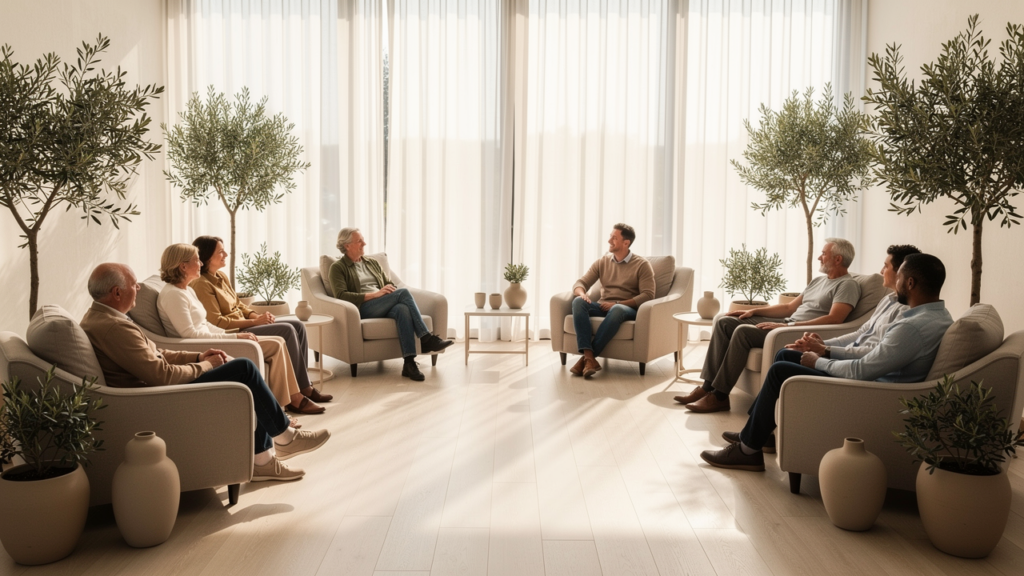
Monthly Community Meetings for Bereaved Families Across Israel provide structured, ongoing peer and professional accompaniment to help individuals process acute and prolonged loss within a shared civic framework. These gatherings combine facilitated dialogue, remembrance practices, and practical guidance for participants navigating different stages of mourning. This article details session frameworks, facilitation models, confidentiality standards, practical attendance preparation, and regional resources available across the country.
Framework and Objectives of Monthly Bereavement Gatherings Across Israel
Monthly community meetings for bereaved families are built around a balance of peer support, emotional safety, and shared remembrance. A typical session lasts between 90 and 120 minutes and follows a consistent outline: an opening grounding exercise to settle the room, an open support circle where participants may speak voluntarily, and a thematic closing segment that often incorporates memorial practices or brief commemoration rituals. This predictable rhythm gives families a stable anchor point during a mourning process that rarely follows a fixed timeline.
Collective reflection during these sessions honors individual histories rather than imposing a single grief trajectory. Two people who lost a spouse in the same year may process the loss in entirely different ways, and the structure is designed to hold both experiences without judgment. Beyond the format itself, the psychosocial objective is straightforward: reduce acute isolation, validate varied expressions of grief, and reinforce a sense of community-based solidarity that formal counseling alone cannot always provide.
Structural Typologies and Facilitation Methodologies
Not every bereavement support group operates the same way. Some are peer-led, run entirely by bereaved family members without a clinical presence. Others are facilitated group sessions guided by a licensed social worker, psychologist, or certified group facilitator responsible for group facilitation boundaries, managing interpersonal friction, and keeping the room emotionally grounded. A smaller subset functions as structured clinical therapy, which differs from community formats in both intent and method.
| Format | Who Leads It | Primary Focus |
|---|---|---|
| Peer-led group | Bereaved family members | Mutual sharing, informal support |
| Facilitated group session | Certified facilitator or social worker | Psychosocial support, structured group guidelines |
| Clinical group therapy | Licensed mental health professional | Diagnostic assessment, treatment planning |
A community bereavement support group is not a substitute for diagnostic care; it centers on mutual resonance rather than clinical intervention. Official frameworks for group emotional support, including facilitation standards and group formation criteria, are outlined by the Support Groups program under Israel's Ministry of Defense.
Groups are also segmented by kinship relationship, bereaved parents, widows and partners, siblings, or adult children each attend cohorts tailored to their relational context. Circumstances of loss, whether tied to military service, hostile action, sudden illness, or accident, further shape thematic coherence, since grief following a combat death differs in texture from grief following prolonged illness. National organizations such as Yad LaBanim maintain local centers that support this kind of segmentation across the country.
Attendance Preparation, Participation Norms, and Privacy Protocols
Attending a grief support meeting for the first time does not require verbal sharing. Participants retain the right to listen silently without pressure, and facilitators typically state this explicitly at the outset. Group guidelines generally call for respectful listening, non-judgmental reception of differing emotional stages, and a firm prohibition on unsolicited advice, since one person's coping strategy may feel intrusive to another.
Trigger management is addressed directly. Participants who feel sensory or narrative overwhelm are encouraged to step out of the room momentarily or signal the facilitator quietly rather than remain in distress. Emotional safety depends on these small, practical exits being normalized rather than treated as disruptions.
Confidentiality carries particular weight in smaller Israeli towns and regional councils, where participants often know one another outside the meeting. A confidentiality agreement, signed or verbally affirmed at the start of each cycle, sets the expectation that identities and personal narratives shared in the room stay within it. This protocol matters especially in tight-knit municipal settings where privacy can otherwise erode quickly.
Geographic Reach, Cultural Inclusivity, and Regional Accommodations
Meetings run across northern, central, and southern districts, as well as Jerusalem and various regional councils, hosted in community centers, municipal welfare branches, and dedicated memorial hubs. Physical accessibility standards typically include wheelchair access and proximity to public transit, while hybrid or fully virtual options serve participants in geographically isolated communities who cannot attend in person. A directory of recognized providers offering this kind of community-based support is maintained through the Support Organizations registry published by the Ministry of Defense.
Linguistic accommodation extends to Hebrew, Russian, French, English, and Arabic, reflecting the country's demographic makeup, while facilitation approaches are adjusted for secular, traditional, and religious sectors alike. Loss also reshapes family systems grief across generations; a parent's death affects children and grandchildren differently at different life stages, and programs increasingly build in space to address this long-term post-loss adjustment within the family unit rather than treating grief as an individual experience alone.
Differentiating Community Support from Specialized Clinical Care
A monthly gathering is not designed to treat traumatic grief or complicated grief, both of which involve unremitting functional impairment that extends well beyond typical bereavement trajectories. Warning signs, persistent inability to function at work or home, prolonged dissociation, or intrusive re-experiencing of the death, generally call for individual psychotherapy, psychiatric assessment, or trauma-focused modalities such as EMDR or prolonged exposure therapy. Facilitators trained in these settings follow a referral protocol, directing participants to clinical social services or medical professionals when severe depression, dissociation, or acute self-harm risk becomes apparent during a session.
All information about the business is available at the following link: idfwo.org.
Non-clinical groups still play a meaningful role in resilience building, functioning as an adjunct to individual care rather than a replacement for medical or psychological treatment. Many participants attend both a monthly group and individual therapy concurrently, using each for a different purpose.
Long-Term Sustenance and Group Transition Dynamics
Needs shift as time passes. Early attendance often centers on crisis processing, while participation after a year or more tends to move toward long-term integration and legacy preservation, remembering the person who died in a way that fits into an ongoing life rather than defining it entirely. If a particular support circle feels misaligned, whether due to mismatched grief stage or interpersonal friction, transferring to another cohort or a specialized format carries no stigma and is generally treated as a routine adjustment.
Closed facilitated group session formats run for a defined number of meetings and end with a structured closure process, often marking the final session with a dedicated remembrance activity. Open formats continue indefinitely, allowing new members to join as needed. Experienced participants frequently move from attendee to informal mentor, taking on community volunteerism or peer accompaniment roles that extend the support network beyond the scheduled monthly meeting.
A note for readers seeking further verification: given the sensitivity of bereavement support data, additional research from neutral academic or public health sources is advisable before drawing broad conclusions about outcomes across different group formats.
Is prior registration required to attend a monthly bereavement meeting?
Most groups request advance registration through the hosting organization or municipal welfare office, primarily to manage group size and confirm eligibility by kinship relationship or type of loss.
Can a participant attend without speaking during the session?
Yes. Silent attendance is explicitly permitted, and facilitators generally state at the beginning of each meeting that sharing remains optional.
What happens if a support group no longer feels helpful?
Participants can request a transfer to a different cohort, a specialized format, or a referral toward individual clinical care without any procedural penalty.
Are meetings available in languages other than Hebrew?
Many regional programs offer sessions or facilitation support in Russian, French, English, and Arabic, depending on local demand and facilitator availability.
About the Business
The IDF Widows and Orphans Organization (IDFWO) is the sole organization recognized by the State of Israel to represent and support the widows and orphans of fallen Israel Defense Forces soldiers and security personnel. It provides psychosocial, economic, and community services to bereaved families across the country, including educational scholarships, subsidies for emotional counseling, therapeutic retreats, and continuous accompaniment through lifecycle events such as weddings, military service, and the birth of children. The organization operates on a founding commitment that no bereaved spouse or child walks alone, offering lifelong support anchored in dignity, solidarity, and mutual responsibility.